Offer and agreement · A guide for Israel

Offer letter or employment agreement: what is the difference in Israel?

An offer letter is a short document that presents the main terms to a candidate, such as role, salary, scope of the position and start date, and asks for a reply. An employment agreement is the full document both parties sign, setting out every term of employment. The offer opens the deal; the agreement closes it.

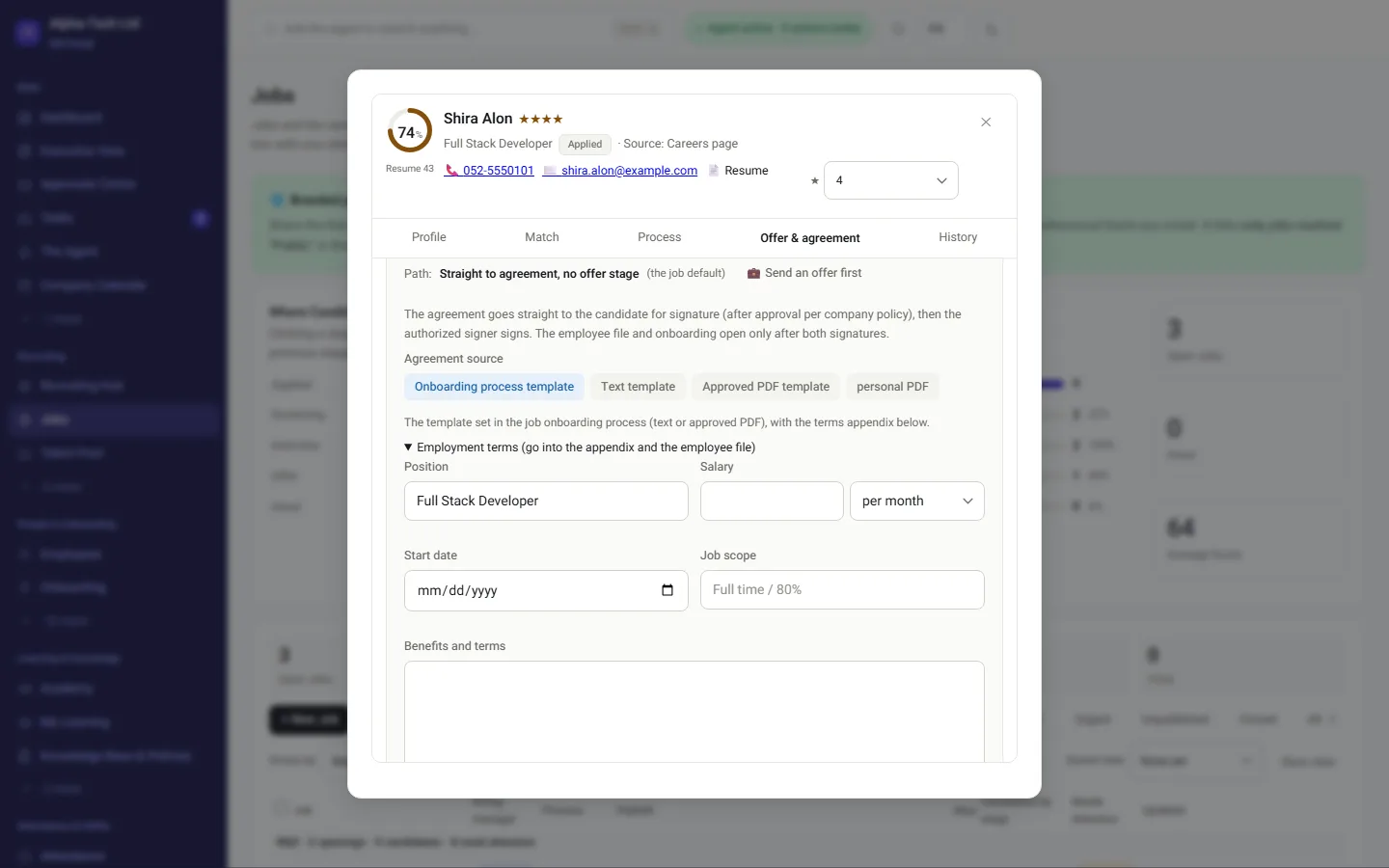
Sending an agreement from the candidate card in HRAI: choosing the source and the approvals
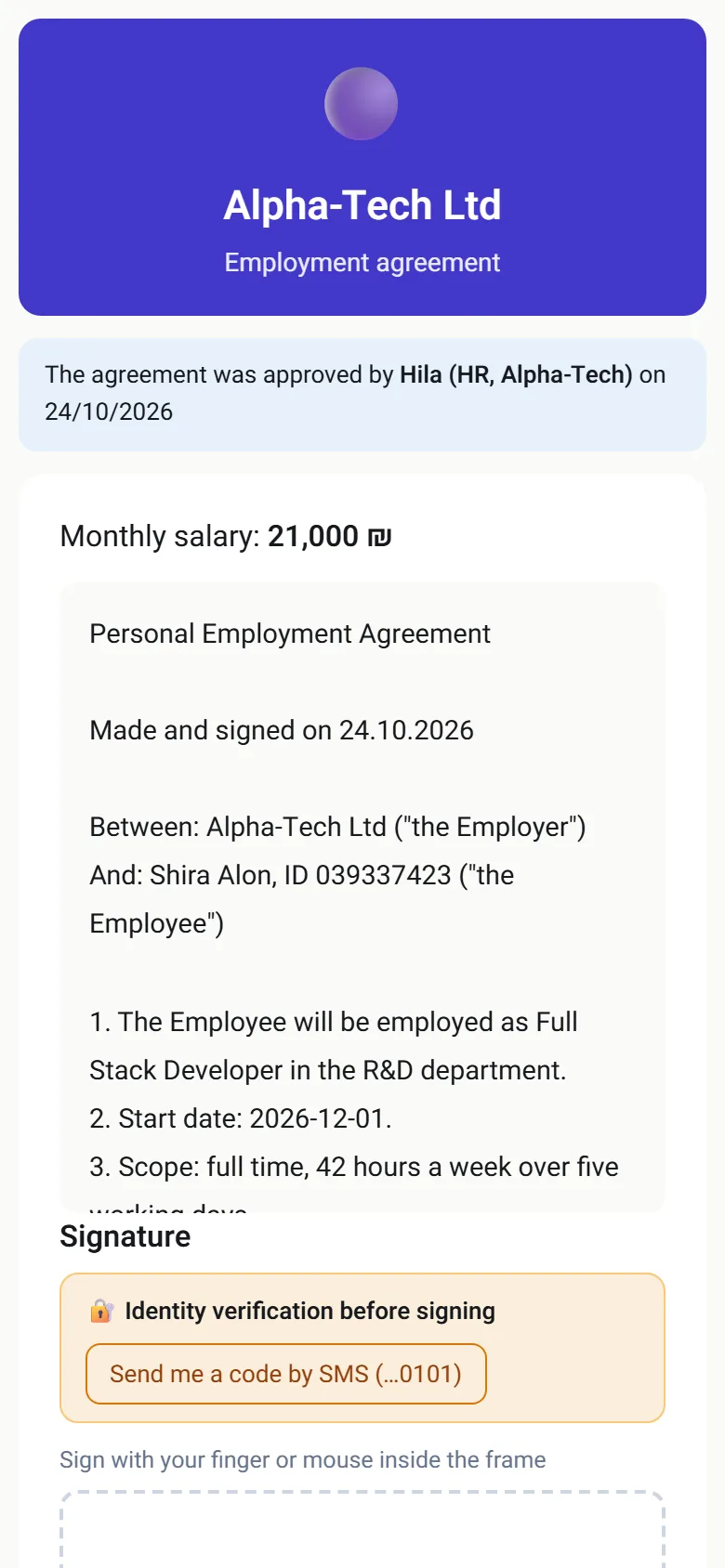
The agreement page on a candidate’s phone: verification code and signing
Sending an agreement from the candidate card, and the signing page on a phone.

At a glance

Why two documents, with two jobs?

The offer asks: these are the terms we propose, do you agree? The agreement says: these are the terms we agreed, and we both commit to them.

Offer letterA short document with the main terms What is in itRole and base salaryScope of the position and workplaceProposed start dateA deadline to reply When it is sentOnce the decision to hire is made What happens nextThe candidate accepts, declinesor makes a counteroffer Employment agreementThe full document with every term What is in itRole and direct managerEvery pay component and pay datesHours, rest and social benefitsAs needed: probation, notice, confidentiality When it is signedWhen negotiation is over Who signsBoth parties Agreed The offer opens the deal, and the agreement closes it
What usually goes into each document, when it goes out, and who replies or signs.

Definitions

Why not send the agreement straight away?

Definitions

An offer letter says: these are the terms we propose; do you agree? An employment agreement says: these are the terms we agreed, and we both commit to them. The offer goes out when the decision to hire is made. The agreement is signed when negotiation is over.

Also called: offer of employment, job offer, employment contract, personal employment contract.

Agreement straight away
  • Fits when there is nothing to negotiate
  • When salary, scope or date are negotiated, the agreement goes back for edits again and again
  • The lawyer rereads it every time
Offer first, then agreement
  • The short offer absorbs the negotiation
  • The full agreement is written once, from the final round
  • Fewer versions, and fewer rereads

In HRAI the default after interviews is sending the agreement directly; an offer stage can be added to a job’s process, or for a single candidate, when there is something to negotiate.

What goes where

What usually goes into an offer, and what into the agreement?

What is usually included in a job offer and in an employment agreement
TopicOffer letterEmployment agreement
The roleJob title and a short descriptionRole description and the direct manager
PayBase salary and the main componentsEvery pay component and the pay dates
Scope and hoursScope of the position and workplaceRegular working hours and the weekly rest day
Start dateA proposed dateThe agreed date, and the term if the employment is fixed-term
Social benefitsA general mentionPension, study fund, vacation and other benefits, by law or agreement
Probation and notice periodSometimesUsually
Confidentiality and intellectual propertyUsually notAs the role requires
Reply deadlineBy when to replyNot relevant: the agreement is signed once terms are agreed

What the law requires

What does Israeli law require you to give employees in writing?

The Notice to Employee and Job Candidate Law, 5762-2002 (Hok Hoda'a la'Oved, חוק הודעה לעובד ולמועמד לעבודה) requires an employer to give the employee a written notice of the main terms of employment, no later than 30 days from the start of work (section 1).

30 daysfrom the start of work, at the latest, to deliver the notice (section 1)
30 daysas a rule, for written notice of a change in terms (section 3)
Section 2(d)a written agreement with all the details, delivered on time, meets the duty
Among the details the law lists (section 2)
  • The identity of the employer and the employee, and the start date.
  • The term of employment, if it is fixed-term.
  • The role description, and who the direct manager is.
  • The salary and its components, and the pay dates.
  • The length of the regular working day or week, and the weekly rest day.
  • Payments for social benefits, and the bodies they are paid to.
  • If a collective agreement applies, its details and the parties to it.

A written employment agreement that includes all these details and is delivered on time also meets the notice duty (section 2(d)). A short offer letter usually does not include all of them, so it usually does not replace the notice.

As a rule, a change in one of the details after work has started also requires written notice to the employee within 30 days (section 3). A change that follows from a change in the law, or that appears on the payslip, does not need a separate notice.

The exact details, the exceptions and what applies to your organization depend on the circumstances. Check them with an employment lawyer.

When an offer commits you

When does a job offer already create a commitment?

Under the Contracts (General Part) Law, 5733-1973 (Hok Ha'Chozim, חוק החוזים (חלק כללי)), a contract is formed by offer and acceptance (sections 1 to 5). So a detailed job offer that the candidate accepted can commit both sides even before a full agreement is signed. Section 12 of the same law requires good faith in negotiation too, so withdrawing an offer at a late stage can also raise questions.

Offerspecific, and delivered The reply Acceptance, with no changecan create a contract · sections 1–5 A reply that adds, limits or changesis a new offer · section 11 Another round of negotiation
Offer, acceptance and counteroffer under the Contracts (General Part) Law.
The practical conclusion: put in the offer only terms the organization is prepared to stand behind, state a reply deadline, and if the offer is conditional, such as on reference checks or internal approval, say so explicitly.

Whether a particular offer commits you depends on its wording and the circumstances. In a specific case, consult an employment lawyer.

Negotiation

How many rounds of negotiation does an offer need?

Negotiating a job offer is normal, not a sign of trouble. It becomes risky only when it scatters across a phone call, an email and a message, and in the end nobody is sure what was agreed.

And under the Contracts Law: a reply that adds, limits or changes something in the offer is not acceptance but a new offer (section 11). So a counteroffer opens a round; it does not close one.

  1. Every round in writingEven if it started in a call. A short summary of what was offered and what was answered.
  2. Every version keptSo you can see what changed between the first round and the last.
  3. One source for the agreed termsThe agreement is written from the last round, not from a hand copy of an old email.
  4. Approval for unusual termsWho in the organization approves a salary above a threshold, and when, is decided before negotiation starts.

After acceptance

What if terms change after the offer was accepted?

The candidate asks for a change before signingThat is another round: answer it, and if you agree, update the terms before the agreement is sent.
The organization asks for a change after acceptanceEspecially one that is worse for the employee: usually requires consent, and is not done by a one-sided notice.
A change after work has startedAs a rule, requires written notice of the detail that changed.

In every case, the signed agreement should reflect the final terms. A gap between what the offer said and what the agreement says is where misunderstandings begin.

Changing material terms, especially to the employee’s detriment, is a topic to check with an employment lawyer before acting.

From offer to agreement in HRAI

How do both documents travel the same path?

The offer, the rounds, the agreement, the approvals and both signatures follow one path. When something goes back, you see where to and why.

1OfferIn a personallink2ReplyAccept, orcounteroffer3AgreementFrom thecompanytemplate andthe agreedterms4ApprovalsBy the policyyou set5CandidatesignsOn a phone,with an SMScode6CompanysignsOptional AIreview first,as an aid2 signatures7OnboardingOpens by itself
1OfferIn a personal link2ReplyAccept, or counteroffer3AgreementFrom the company template andthe agreed terms4ApprovalsBy the policy you set5Candidate signsOn a phone, with an SMS code6Company signsOptional AI review first, asan aid2 signatures7OnboardingOpens by itself
Two ways back a round: a counteroffer, and a change request before signing. A declined offer does not open onboarding.

What it looks like

What do HR and the candidate see?

The offer

An offer in a personal link

In HRAI the offer is sent in a personal link that opens with an SMS code. Candidates reply, or submit a counteroffer, and every round is kept.

  • Terms, salary and start date in one form
  • The agreement is built from the company template together with the agreed terms
  • Approval by the policy you set
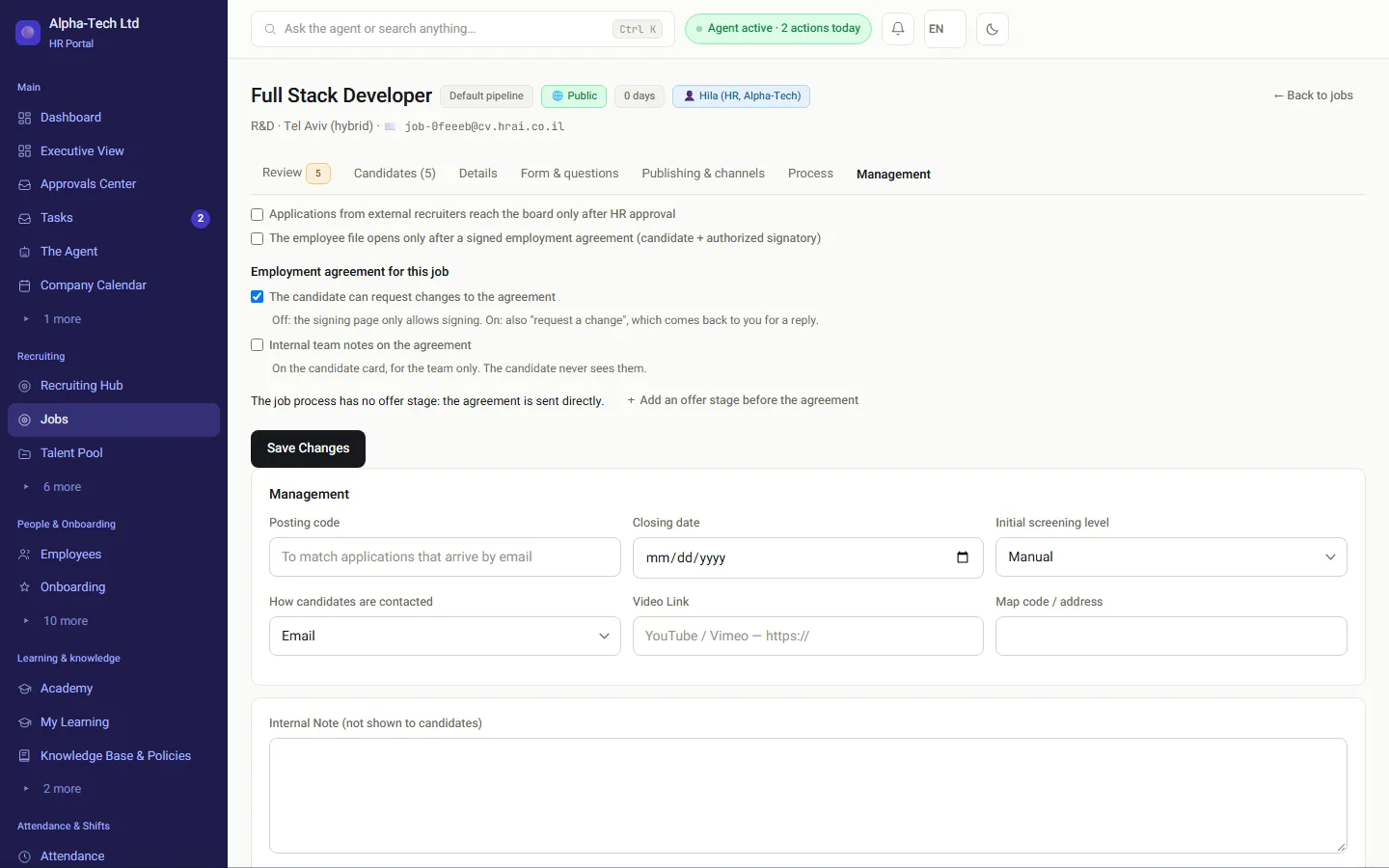
Agreement settings on a job in HRAI: the process and the change-request option
The agreement

A change request, then signing on the phone

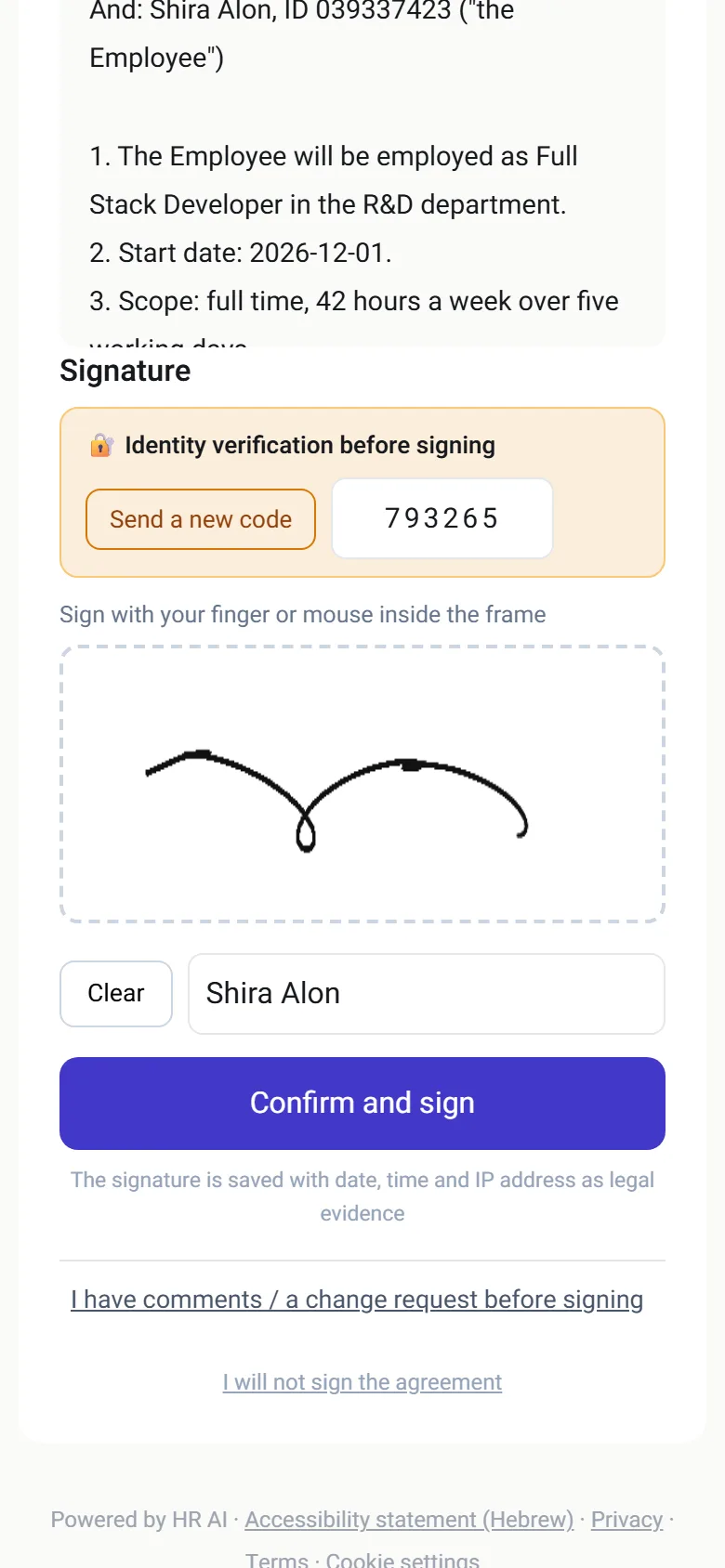
The agreement is signed on a phone with an SMS code. Candidates can ask for a change before signing, and you see when the agreement was opened. Before the company signs, you can run an AI review that flags clauses for a second read.

Important: the AI review is an aid, not legal advice.

Once both sides have signed, onboarding opens by itself. Candidates who declined the offer do not enter onboarding. The full picture: e-signing employment agreements. And what happens from signing onward: the onboarding checklist for Israel.

The agreement page on a phone: code verification and signing with a finger on the screen

Get started

From offer to signed agreement, on one path

In the demo we send an offer to a phone, answer a counteroffer and see how the last round becomes the agreement, on your template if you like.

Sources

Official sources for this guide

  1. Notice to Employee and Job Candidate (Terms of Employment and Screening and Hiring Procedures) Law, 5762-2002, Nevo (Hebrew)Section 1: the deadline for delivering the notice. Section 2: the details in the notice, and section 2(d): a written employment agreement as the notice. Section 3: notice of a change in terms.
  2. Contracts (General Part) Law, 5733-1973, Nevo (Hebrew)Sections 1 to 5: offer and acceptance. Section 3(b): an offer with a deadline. Section 8: the time for acceptance. Section 11: acceptance with a change. Section 12: good faith in negotiation. Section 23: the form of the contract.

Nevo texts are consolidated versions; the authoritative text is the one published in the official gazette (Reshumot). All sources are in Hebrew. Sources checked on October 24, 2026.

Frequently asked

What people ask before they start

Can a job offer already commit the employer?

It can. If you want the offer to be an interim step rather than a final commitment, say so explicitly: that it is subject to signing an employment agreement, and what the preconditions are, such as reference checks. Such wording does not remove the duty of good faith in negotiation, so have the text checked by an employment lawyer.

Is a signed employment agreement required in Israel?

The law requires giving employees a written notice of the main terms of employment. It does not require a signed agreement as such, but a written agreement that includes all the required details and is delivered on time also meets the notice duty. Most organizations prefer an agreement, because it also covers topics the notice does not.

How soon must the notice of employment terms be given?

Under the Notice to Employee and Job Candidate (Terms of Employment and Screening and Hiring Procedures) Law, 5762-2002, no later than 30 days from the start of work. That is the latest date: delivering it before day one lets misunderstandings be resolved before work begins. A change in terms also needs written notice, generally within 30 days.

Can a job offer be sent by email or message?

Yes. As a rule, the Contracts Law allows a contract to be made orally, in writing or in another form (section 23). What matters is that the terms are written in full, a reply deadline is stated, and the reply is kept. A phone call leaves no record, so summarize every call in writing.

How long is a job offer valid?

When the offer sets no deadline, the Contracts (General Part) Law says it can be accepted within a reasonable time (section 8), which is open to interpretation. So it is common to state a date by which to reply. Note: whoever set a deadline for acceptance cannot withdraw the offer once it was delivered (section 3(b)).


Get started

Book a demo

Leave your details and we will get back to you within one business day to set a time for a 30-minute demo on your own processes. If it turns out not to be a fit, we will say so.

About the details you share. Data controller: Career and Content ltd (operator of HR AI), company no. 515523934, [email protected]. You are not legally required to provide them; without a name and email we cannot get back to you, and that is the only consequence. The information is used to respond to your inquiry, kept for up to 24 months, and shared only with our email provider and our sales team. You may review, correct or delete it at any time at the same address — Privacy Policy (Hebrew), English summary.