Shift scheduling under Israel’s Hours of Work and Rest Law
To keep a shift roster within Israel’s Hours of Work and Rest Law, check it before publishing, for each employee across the whole week: the length of the working day, a 42-hour week, weekly rest of 36 consecutive hours, night shifts of up to 7 hours and 8 hours’ rest between shifts. By payslip time it is too late.
By Merav Sella and Shai Truchman ·
Published · Last reviewed .
Legal rules on this page are quoted with their source. This is general information, not legal advice.
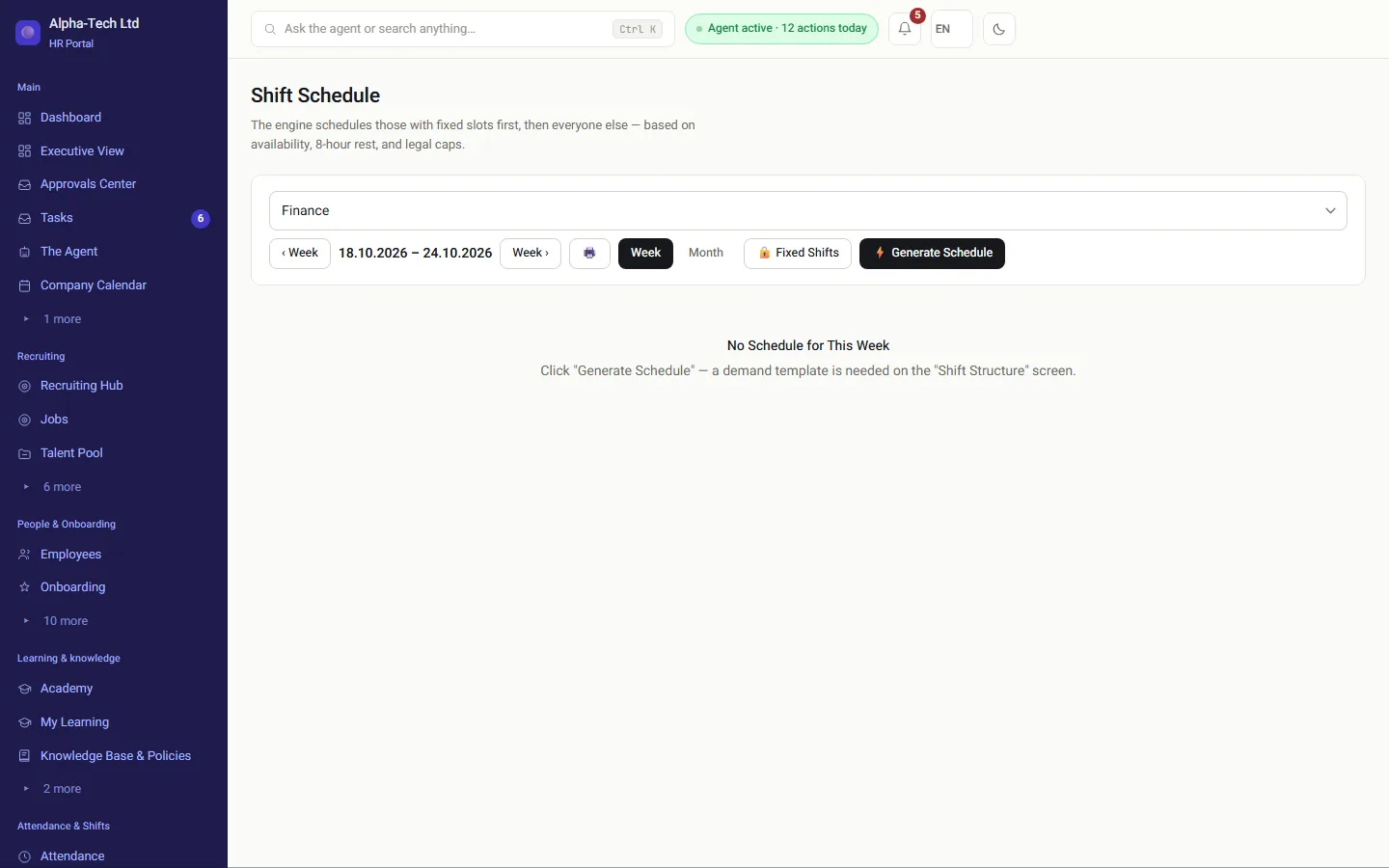
A weekly shift board in the demo environment. Above the board: how many shifts and hours each employee got this week.
The week
What does a compliant week look like for one employee?
Every column of the roster can look fine while the breach hides between two columns. That is why you look at each person’s week from start to finish.
The rules
Which rules are easiest to break in a roster?
Roster breaches are rarely deliberate. They are the result of a roster built day by day, when nobody looks at one employee’s week from start to finish. These are the rules of the Hours of Work and Rest Law, 5711-1951 (Hok Shaot Avoda u'Menucha, חוק שעות עבודה ומנוחה) that usually break.
42hours in a standard working week
36hours of consecutive weekly rest, minimum
8hours’ break between working days, minimum
7hours, at most, in a night shift
Roster rules under the Hours of Work and Rest Law: what each says and where it breaks
Rule
What it says
Where it breaks
Working day
The law sets an 8-hour day. Under the extension order, a five-day week is usually 8.6 hours on four days and 7.6 on the shortened day. On a six-day week, up to 8 hours, and 7 on the day before the rest day.
A double shift built to plug a gap, which turns into overtime nobody planned.
Working week
42 hours a week under the extension order on shortening the working week, with one shortened day. Beyond that, overtime. Some sectors and the public sector work a shorter week.
Available employees scheduled again and again because they are easy to rely on.
Rest between shifts
A break of at least 8 hours between one working day and the next (section 21). In HRAI the rule is checked as 8 hours’ rest between the end of one shift and the start of the next.
An evening shift followed by a morning shift, in a pattern that looks fine on each day alone.
Weekly rest
At least 36 consecutive hours every week, including the rest day: Saturday for Jewish employees, and Saturday, Sunday or Friday for non-Jewish employees.
Scheduling on the rest day and the next morning, after an evening shift the day before.
Night shift
A shift with at least two hours between 22:00 and 06:00. A night shift is up to 7 hours. In a plant working shifts, no more than one week of nights in every two weeks.
A night shift as long as a day shift, because the pattern was copied.
Work on the rest day
Allowed only where the law permits, usually under a permit, and paid at a premium.
Regular scheduling on the rest day without anyone checking whether there is a permit.
Overtime has its own legal limit, per day and per week. The limits have changed over the years, and they depend on the arrangement that applies to the workplace. A collective agreement, an extension order or a special permit can change any of the rules here. So check the roster against the arrangement that actually applies to you, not against habit.
The table summarizes the defaults of the Hours of Work and Rest Law (sections 2, 7, 9, 21 and 22) and of the extension order. The law does not apply to every role (section 30); for a question about a specific employee or sector, check with an employment lawyer.
Planning
How do you plan a week of shifts?
Six steps. The fourth is the one that gets skipped.
The fourth step is often skipped. A roster built as a table of days against shifts hides each employee’s week: every column looks fine, and the breach sits between two columns. So go over the roster once more, this time one row per person. And the starting point is demand, not employee names.
A fixed template, checked again every week. Many managers build a weekly template and copy it. It saves time, but a week with a holiday, a vacation or a new employee changes the picture, and a template that was fine last week can break rest this week.
A fair share of the hard shifts. When nights and weekends are shared out first, it is easier to share them fairly. A roster where the same people always get nights and weekends leads to resignations and swap requests. Track how many nights and rest-day shifts each employee had last month, and balance next week.
Swaps
How should shift swaps be approved?
Three parties to every swap
Swaps are where a lawful roster becomes unlawful without anyone meaning it. Two employees agree in a WhatsApp group, the shift changes in practice, and the roster in the system stays as it was. Attendance records someone who was not supposed to come, and one of them got a shorter rest.
Three parties. The person asking, the person agreeing to take the shift, and a manager who approves. A party to the swap does not approve it.
A check for both sides. The swap is checked against the rules for both employees. A shift that is fine for the requester can break the replacement’s rest.
Open shifts, same rules. A shift that was freed up and offered to everyone goes through the same checks. Whoever grabs it first is not necessarily someone you may schedule.
Publishing
How should you publish the roster to employees?
One version gets publishedA draft stays with the manager until it has been checked. Employees see only what was published, not three versions that went round during the week. A roster that arrives early reduces swap requests and no-shows.
A change reaches whoever it affectsA general message to the whole team gets lost. A personal message to the person whose shift changed gets read.
The roster is the reference pointAttendance is checked against the published roster: who was due and did not come, and who came on a day they were not scheduled. Night and rest-day hours for payroll also come from that roster, so keep previous versions with the date each was published.
Clocking in is the other half of the picture: the roster says who was supposed to work, and the record says who actually worked. How to choose a recording method for shift workers: do you need a time clock? And how the month gets from there to payroll, including night and rest-day hours: sending attendance to the payroll department.
In HRAI
How does HRAI schedule shifts?
The rules are checked before anyone is scheduled
The rules above are checked before scheduling, and a manual assignment that breaks them needs explicit approval that is logged.
The published board is sent to employees, and swaps go through all three parties.
Hours of Work and Rest Law, 5711-1951, Nevo (Hebrew)Section 1: definition of night work. Section 2: an 8-hour working day, and 7 hours at night and on the day before the weekly rest. Section 7: weekly rest of 36 hours. Sections 9 and 17: work during the weekly rest and its pay. Section 21: the break between working days. Section 22: night work in shifts.
Nevo texts are consolidated versions; the authoritative text is the one published in the official gazette (Reshumot). All sources are in Hebrew. Sources checked on October 24, 2026.
Frequently asked
What people ask before they start
How many hours of rest are required between shifts in Israel?
Under section 21 of the Hours of Work and Rest Law, there must be a break of at least 8 hours between one working day and the next. HRAI checks at least 8 hours’ rest between the end of a shift and the start of the next one. A collective agreement or an extension order in your sector can set a longer rest, so check what applies to you.
What counts as a night shift?
Under the Hours of Work and Rest Law, a shift with at least two hours between 22:00 and 06:00. It is shorter than a regular working day: a night shift is up to 7 hours. Even when it crosses midnight, it is checked as one continuous shift, not as two separate days.
How many hours is a standard working week in Israel?
The standard working week is 42 hours, under the extension order on shortening the working week. Hours beyond that are overtime: they are paid at a premium and have their own legal limit. The limit that applies to you, including special permits, is worth confirming with an employment lawyer.
Can we schedule employees on the weekly rest day?
Work on the rest day is allowed only where the law permits it, usually under a permit, and it is paid at a premium. In addition, every employee must get a weekly rest of at least 36 consecutive hours (section 7 of the law). Before scheduling on the rest day regularly, check the permit that applies to the workplace.
What if we have no choice and need to break the rules?
Exceed them only within what your arrangement allows, for example an overtime permit or a rest-day permit. Even then, document who approved it, when and why, and pay the premium. An exception that repeats every week usually signals a staffing shortage, not a rule that does not fit.
Get started
Book a demo
Leave your details and we will get back to you within one business day to set a time for a 30-minute demo on your own processes.
If it turns out not to be a fit, we will say so.
About the details you share. Data controller: Career and Content ltd (operator of HR AI), company no. 515523934, [email protected].
You are not legally required to provide them; without a name and email we cannot get back to you, and that is the only consequence.
The information is used to respond to your inquiry, kept for up to 24 months, and shared only with our email provider and our sales team.
You may review, correct or delete it at any time at the same address —
Privacy Policy (Hebrew),
English summary.
We only keep what we need
Essential cookies run the site and cannot be switched off. Everything else is your
choice, and you can change it whenever you like.
Cookie policy (Hebrew), English summary.